Dredd (2012) Review

Dredd is the 2013 live action comic book adaptation of the long-time published “Judge Dredd” stories. “Judge Dredd” was also adapted into a Stallone-starring 90s cheesefest whose reputation is likely a big reason for this films low gross. Dredd is considered a box office bomb, but its considerable video sales leads one to take a second look at this movie. Can it really be passed off as a forgettable and shitty action flick like it’s predecessor? No, in actuality Dredd is a fairly clever and fun movie that manages to walk the line between gritty and self-mocking rather well.

In the post-apocalyptic future, humanity has been forced to create a mega city in order to survive. This city is riddled with crime, poverty and all around chaos. The only thing that stands between the citizens and complete anarchy are The Judges, the police force for this city. With their handy gadget equipped guns they both catch and punish criminals at their discretion. Enter Dredd, a long time veteran of the force who is required by his superior to field-test a rookie with unique psychic powers. On their day out, they respond to a triple homicide, which was caused by mob-boss Ma-Ma and her crew. In order to arrest Ma-Ma and stop her drug-trafficking, Dredd and the rookie fight their way to the top of the massive living block, facing a myriad of obstacles along the way. Standard action fare indeed, but what makes Dredd unique is the world it takes place in, the characters involved and satirical manner in which it point’s out its own flaws.

The world of Dredd is a surprisingly believable one. It has enough generic qualities for us to fill in the details, but it’s also unique enough that it doesn’t feel like we’ve seen it a thousand times. The Mega City has character and specifically the Block that the majority of the movie takes place in. You get a feeling for the relationships between the people, criminals and judges, even if the majority of it is delivered in extremely clumsy exposition. Hell, the monologue Dredd gives to tell us all about the city is so generic that the film decides to do it again at the end for funsies, but of course with even cheesier lines.

Speaking of funsies, this film knows that it’s not Apocalypse Now. It knows its tropes and while it doesn’t shove it’s knowledge of it in your face like You’re Next it does utilize humor to point out its more noticeable failings. The one-liners that Dredd gives are so cheesy they couldn’t have been written without intention. I’ve found lately that a lot of movies that know what they are and use a little “winkwinknudgenudge” over the course of the movie, usually end up being quite entertaining (ie. Sharknado) and maybe thats the key when it comes to doing adaptations of clearly generic material like Dredd is.

Rather unusually for a movie of this caliber, there are only three characters worth talking about in this movie. Ma-Ma, Dredd, and the psychic woman Anderson. Anderson is an odd duck, not really played for the naive, innocent rookie she could have been or the sensitive girl psychics usually are portrayed as. To the contrary, she’s quite brutal at times and even though her psychic powers clearly define her character, she still develops by the end of the movie. Ma-Ma is the generic villain, but her clumsily delivered back-story does give you a sense of meaning behind her actions and for that I applaud the actress for her mediocre, but still effective performance. Dredd is another story. He’s somewhere inbetween Batman and Punisher, but still has a unique enough of a flair to him that you can tell there’s a person behind that helmet and not a robot or Christian Bale. While he doesn’t develop per-say by the end of the movie, we do get to see a range of reactions from him that help us understand who he is. He’s a character I would love to see in another movie, even if he isn’t accompanied by Anderson.

Amongst the 3D craze taking Hollywood by storm, and to some extent driving it into the ground, it’s rather rare to find a movie actually made with 3D in mind and not just translated in post for extra cash. Dredd is one of these rarities, throwing all kinds of shit at the screen and utilizing slow motion for added effect. It’s a film in retrospect I think most would want to see in 3D, but maybe not for the price of 3D. The aforementioned effects are rather good. They’re not state of the art by any means, but they are utilized in a unique way and are ultimately effective, which is what counts. The visual style is also unique when it comes to the slow-mo drug or action sequences and this style really makes it feel comic-booky somehow, even if I’m not sure why.

If you’re looking for a fun evening with friends, then by all means check out Dredd. It’s a fun hour and a half with brutal violence and action scenes, but enough engaging story points and characters to keep you interested even when the guns aren’t firing. Dredd is an underrated gem in the rough and I think its cult following is only going to grow, even if a sequel is naught to be. Dredd is currently available on Netflix streaming and Amazon Instant, as well as Redbox and Blockbuster.
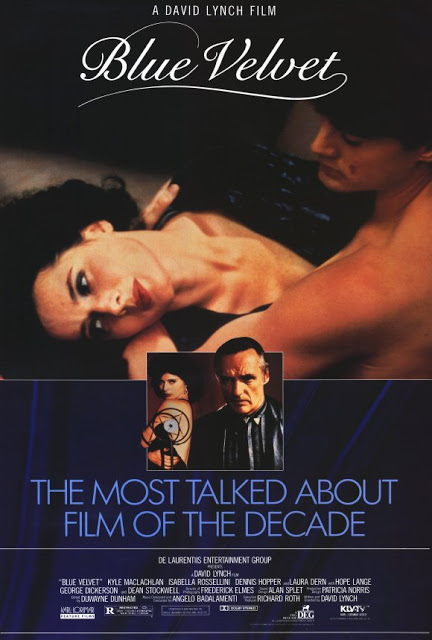
Blue Velvet (1986) Review

Out of all the directors I’ve come across in my cinematic travels, David Lynch is probably one of the most memorable of the lot. I’ve only seen two of his films, but I will never ever forget them. His magnum opus of oddity Eraserhead remains continually stuck in my brain as a movie I need to see several more times. If you haven’t seen that, check it out. You will literally never forget it, barring mental disease. His transition to Hollywood after Eraserhead is just as interesting and coming of the reasonably unsuccessful Dune, he released 1986’s Blue Velvet. It’s Lynchian nature is definitely present, but almost weaved in and out of a movie that most will enjoy. Blue Velvet is a conundrum in my head, and coming off of just watching it, I may be in the worst position to review it. It puts you under a spell, entrancing you with its story and then yanking you back and forth with its symbolism that you should obviously be seeing, but not quite understanding. So let me try and put my inquiring mind aside and actually look at the film that captivated me so.

The film centers around Jeffrey, whose investigation into an ear he found leads him to Dorothy Vallens. Along with Detective’s daughter Sandy he unravels the mysterious goings on in Dorothy’s life, ultimately becoming involved in them himself. The acting is hard to judge. It’s convincing, but convincingly weird. We somehow get the impression that the odd line reads and inconsistent interactions are part of the world and eventually they make sense in their own way. Stand out performances go to Isabella Rossellini as the tormented Dorothy and Dennis Hopper as Frank Booth. Frank is a fascinating character. His entrance into the film marks a turning point where the movie changes from a mid-50s Hitchcock movie to an 80s drama and boy oh boy could you dissect his character for hours. The odd combination of inadequacy, possibly homosexual tendencies and over-compensation are absolutely fascinating to watch.

As I said before this film starts out very 50s in its style and setting. It’s colors, suggestive imagery and characters all suggest 50s suburbs. It’s not until we get to Dorothy’s apartment that the darker world starts to infest the movie. Then when Frank shows up the movie completely flips, immersing Jeffrey and the world into the darkness and it’s only with the help of Sandy and her love for Jeffrey that the world is once again brought into the light. It’s tough to believe that “Love Conquers All” is the message in a Lynch film, but the cyclical nature of the symbols and motifs seem to suggest it. Again, another watch is needed.

The colors and light are played on constantly in this movie, making it feel like a colored film noir. Lynch seems to love working with shadows, in a way very reminiscent of German expressionism. It pervades through the movie and even if you can’t garner it’s meaning, it’s certainly something to look at. The color as well is unique to look at, as for a movie called Blue Velvet it certainly has a lot of red. Almost all the shots have some primary pop to them, but reds seem the most dominant. Perhaps to give more contrast to the blues.

Blue Velvet is a suspense movie that remains suspenseful for the entirety of the movie. The sense that there is more going on then meets the eye adds to the experience and most certainly gives it rewatchability. You absolutely should see this film. If you are even slightly into stranger movies, of any kind, then this will give you plenty to feast on and if you’re as into film as I am, then this movie will be great discussion fodder for a long time to come, especially if it’s accompanied by Eraserhead. So while I haven’t talked much about the quality of this film, I’m sure you can tell from my gushing that Blue Velvet is worth your time.

Friday the 13th (1980) Review

Friday the 13th will forever be notable for it’s popularization of the slasher genre and kicking off the 80s slasher boom. The Friday franchise was Paramount’s dirty little secret, bringing in more money on an annual basis then any of their other features. Despite the lashing that it got from critics, Friday the 13th isn’t that bad of a movie. It follows the now cliché structure of a group of camp counselors getting picked off one by one at Camp Crystal Lake, which has a history of tragic events including the drowning of the young Jason Voorhees. As the body count rises, the final survivor discovers who the killer is and has to fight her to survive. Friday the 13th is a great movie thanks to its likeable characters, good pacing, and moderation of kills and scares.

As the slasher genre progressed, more and more emphasis was placed on the killer and less on the victims, at first leading to clichéd characters and eventually leading to every slasher starring obnoxious pieces of shit that you desperately want killed so you don’t have to spend more time with them. However, thinking back to the greats (For example Friday the 13th, Halloween, Nightmare on Elm Street, and Scream) they have likeable leads or, at the very least, leads you don’t hate. Friday’s leads are generally likeably people, even if they’re a little bland. They’re certainly not clichés, having their own personalities to them, but because we don’t spend enough time with them to know what they’re like, they come off as bland. The acting is… fair, certainly not as bad as some of its successors, but nothing outstanding. Kevin Bacon makes an early career appearance, but he’s got so few lines that you barely notice. The standout performance definitely goes to Jason’s mother, played by Betsy Palmer. She seems to be not only a caring mother, but also a fucking schizophrenic and that’s tricky to pull off.

Since Friday the 13th took up the task of actually getting you to like its protagonists, it ran the risk of getting quite boring. In spite of this, it managed to pace itself quite well. The movie kicks off with a good introduction and then from there does an even better job of throwing in occasional kills or teen antics to keep you interested. It’s never boring, even if it doesn’t grab your interest like some of its successors do. The build-up to the climax takes up a solid chunk of the movie, with neither too much nor too little time in-between the kills. The only real problem the film has pacing wise is that the climax is too long. The fight with Mrs. Voorhees has many different confrontations to it, and there are overly long parts in-between where it’s just the two looking for each other which frankly isn’t that interesting to watch. That being said, all that waiting is worth it for the final kill and scare, which are easily the most memorable parts of the movie.

Speaking of kills and scares, the murders in this movie are… not as gory as you may think. There certainly a good amount of sharp object to head action, but there’s also plenty of kills where we don’t actually see anything. This kind of balance allows for the gore to be effective and for us to remain sensitive. The gore effects are pretty good, but there is such thing as too much of a good thing and this film makes sure not to cross that line. It certainly is an interesting contrast to the later entries, which no longer have the backbone of a mystery to support them and instead concentrate on upping the ante with the kills.

I saw this film, in honor of Friday the 13th, on VHS and I’m glad I did. While some may prefer to get this movie on blue-ray to maximize visual splendor, I prefer the grit and fuzziness that VHS has to offer. It really lends to the tone of the movie and it’s almost like being transported back to the 80s when people were first getting scared by this film. The darkness and dullness of the image actually made the gore effects better, since they blended with the actors more. Seeing the 1080p version of this movie, you can notice a difference, but on VHS it honestly looks like Kevin Bacon’s getting an arrow pushed through his neck.

Should you watch Friday the 13th? Of course you should! It’s cliché, yes. But only because it created the clichés. Is it full of plot holes? Yes, but you’ll be having too much fun to notice. Despite its flaws, Friday the 13th is a film worth watching, not just for horror fans, but for anyone who wants to watch a darker film. It won’t scare you to death, but it still has some effective moments for you to enjoy. For what it is, Friday the 13th is a great movie and one that will surely continue to stand the test of time.

Exit through the Gift Shop (2010) Review

Despite my fascination with art, it is rare that I actually go in depth with it. That is until I heard an NPR story a few months back about Banksy, a British street artist whose ambitious works of art provide fascinating social commentary. This inspired me to look into the unusual displays of art he had and he’s now one of my favorite artists (next to my girlfriend of course ;). So when I discovered Exit through the Gift Shop on Netflix, I had to check it. Strangely enough, this isn’t a documentary about Banksy, but rather the man who “tried” to make a documentary about him and in the end proved to be just as fascinating on his own.

Thierry Guetta is a man with a fascinating psychological urge to record everything and every moment. In the early 2000s he starts tagging along with his graffiti artist cousin “Space Invader” further and further into the world of street art. As he falls down this rabbit hole he decides to make a street art documentary and that the crown jewel of this film will be an interview with the world famous Banksy. Eventually he gets his chance, and his ensuing friendship with the Graffitist allows him to get the ultimate street art thrill ride. With attention on Street Art rising, Banksy urges him to finish the film, but when he does the result… isn’t exactly pleasing. While Banksy is busy remaking the movie, Guetta is allowed to start creating his own art and from there launches a massive campaign under the name “Mr. Brainwash.” Through his connections Guetta takes the LA art scene by storm, despite his insane business decisions and his derivative work.

Thanks to its unique framing, the documentary works extremely well. It’s told with the thousands of hours of footage Guetta has recorded over the years and is accompanied by interviews with Guetta, his family, Banksy and several colleagues. As we follow this mans life we’re mystified by the fact that no one saw his true nature… not as a seeming documentarian, but as a mentally scarred man. He asks the dumbest questions, he does the most intrusive things, and all around acts insane, but somehow he manages to capture the hearts and minds of the street artists who just want a log of their work. Guetta is a thoroughly unlikeable character in my opinion. He goes from being this naïve, but interfering nitwit to this self-centered exploiter who ignores his family and abuses his friends’ work because he wants to be just like they are. It’s clear once he becomes a “street artist” that he has no artistic vision. What gives the simplistic pop art or the unusually designed street art its artistic merit is not just the image itself, but the thought behind it, the intent. Guetta has no concept of this, simply making changes to pre-existing images (like a studio executive does to a script) and then handing it off to someone else to actually create, loosing any artistic merit for even creating the image itself since it’s not his. Yet somehow… you don’t really hate him. He’s just a goofy man riding on a trend. He’s extremely lucky, but if it wasn’t him it no doubt would have been someone else.

What Banksy wanted from Guetta was an accurate portrayal of what street art was supposed to mean during a time where it was being sold for thousands of dollars. What he got in return was a 90 minute nightmare trailer. Hence him sending Guetta off to do something else. While Guetta’s film failed, I think that this movie does, through contrast, establish what Street Art is supposed to be. We see that the people around Guetta have clear passion and that carries through to the moments in Banksy’s studio where we see the real processes behind the creation of these pieces. However, it’s not until we see Guetta in his studio and at his gallery that this message really clicks. Guetta is almost the opposite of what a Street Artist is supposed to be and by using the inverse of him, as well our impressions from the previous artists, we can gain a clear image of what those weird pieces of Graffiti are supposed to stand for and who the people behind them really are.

Exit through the Gift Shop is well made, but with all documentaries it’s the content that counts and Guetta provides no shortage of fascinating content. The art on screen is beautiful to look at, the artists are fun to watch, and Guetta’s commentary both behind and in front of camera is addicting to listen to, like watching a train crash. The moral of the film is clear and in my opinion an important one that pertains not only to the world of Street Art, but Art in general. If you are vaguely interested in Graffiti, have heard of Banksy, or are just looking for a good character piece then Exit through the Gift Shop is definitely worth checking out.

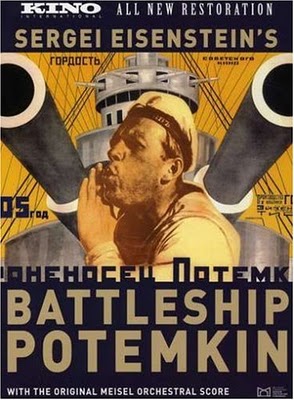
Battleship Potemkin (1925) Review


A dramatized account of a great Russian naval mutiny and a resulting street demonstration which brought on a police massacre.-imdb.com

Battleship Potemkin is a technical masterpiece as it was an experiment in “montage” and its editing techniques remain influential to this day. As a propaganda film it exceeds expectations, presenting a story that’s deeply emotional even for a foreign audience. There is no question that Battleship Potemkin should be seen by every film student, but is it as mandatory for a more casual viewer?

Let’s face it; Battleship Potemkin is a propaganda film. It portrays the government as rats and does nothing to redeem them. However, this is no worse then the way The Empire is portrayed in Star Wars or Loki in The Avengers. There are no real characters to attach to, because this movie isn’t about characters. It’s about a general population and their struggle to have rights and that story is done incredibly well, both for a 1925 film and even for a film today. The story evolves and evolves taking you places you wouldn’t expect, and this makes the film actually a unique watch. For how old this movie is, its story isn’t that cliché and it’s really quite refreshing.

The solid story wouldn’t be nearly as strong if Sergei Eisenstein hadn’t been able to encapsulate the emotion like he did through editing and cinematography. The staircase scene, the fight on the battleship, and the ending scene are all monumentally tense and effective. The staircase sequence alone is shocking enough, especially if you go in with 1920s expectations. Going from a more basic movie like a Chaplin or Keaton work to this will make the film all the more effective. While those movies work just fine, Battleship Potemkin exceeds all expectations and destroys all comfort you may have. The violence used and the shocking portrayal of humanity being destroyed is something that wouldn’t be done today, let alone back then.

Where this film does fail is the uneven pacing. There are plenty of points in-between the more dramatic scenes where the movie just hits a brick wall. People are just standing around talking, or they’re just doing… stuff. Getting ready for war or protesting bad meat, all at a slow pace and with nothing particularly interesting to look at. The soundtrack helps a little as it’s generally very dramatic and nice to listen to, but that doesn’t completely rid you of the creeping sense of… boredom.

If you can make it through the movie, and odds are you will, there will be no doubt that what you watched was totally worth every moment and that you won’t forget it any time soon. Battleship Potemkin is a masterpiece of a movie. Not without the typical pacing problems of the time, it’s still a great watch and in my opinion something that even a more casual viewer can enjoy.

The General (1926) Review

Buster-Keaton
When Union spies steal an engineer’s beloved locomotive, he pursues it single handedly and straight through enemy lines.-imdb.com

Out of all the silent era comedians, Buster Keaton is notable for his lavishly large set pieces and there is perhaps no better example of this then 1926’s The General. With the restrictions of silent era technology, most humor of the time was slapstick, because only a visual was required. Most of the time slapstick is relatively simplistic in its presentation and sophistication; however that doesn’t mean you can’t put a good plot around it and that’s exactly what Keaton did. The General is fairly simplistic. Obviously. The acting, production, etc… isn’t the best. Obviously. But! Keaton does his finest to stretch the limitations of the time to their max.

Keaton’s protagonist is a breath of fresh air from the Chaplin copies that perforated this era; he’s kind, brave, but still clumsy. Keaton’s mugging to the camera may be generic by the times standards, but on occasion his reactions to all the crazy shit going on around him is priceless.

The movie progresses through a civil war landscape (on the southern side nonetheless) with the danger of war always present. This plays back into the plot, but what it really achieves is a sense of tension. The people around Keaton are willing to kill him and this leads to genuine moments where you wonder how he’s going to pull this off and stay alive. The only problem is that when Keaton isn’t on screen, this war backdrop proves immensely boring, but if you’re willing to wait just a little bit longer Keaton will pop back up just in time to provide a few smirks.

This movie is most likely not going to get you to laugh out loud, but chuckles and smirks will abound. The choreography of many of the slapstick scenes is truly astonishing, because they are so sophisticated compared to the rest of the movie. Mock silent film all you want, they had slapstick down to a fucking science. The first act is set piece after set piece and this really is astonishing, not only does it convince you of the Keaton’s comedic genius, but also his general filmmaking genius, since it truly feels like a train chase. Now to be fair this could also be the work of his co-director Clyde Bruckman, but alas we’ll never know.

The General is not your average slapstick movie. This one is big. It’s grand not only in price but scale. The ending train scene is a great example of this, as well as the other primitive effects. This movie was a remarkable achievement at the time and still stands as a classic to this day. If you want to dip your toes into silent film, this is a great way to start and if you’re a silent film fan, then you should have seen this by now.

Seven Samurai (1954) Review


A poor village under attack by bandits recruits seven unemployed samurai to help them defend themselves.-imdb.com

Kurosawa’s Seven Samurai is considered a classic of Japanese cinema and has spawned many American copies, such as The Magnificant Seven and A Bugs Life. But how does this 1954 movie hold up today? Quite well actually. For its length (over 3 hours) and place at the beginning of Japanese cinema, Seven Samurai has an engaging plot, unique characters and genuine moments of tragedy, comedy, and tension.

Seven Samurai has the plot of a film you’ve seen before. It’s spawned so many clones, that it’s nice to see the original in all its glory. That being said, it’s not perfect. The films pacing is rather uneven, with the first act moving at a very quick pace, which was refreshing until the second act started dragging on way too slowly. The films length definitely is correlated to this and maybe if some cutting had been done to that second act, a more compressed and smooth story could have been created. That’s not to say that the second act is bad, it still upholds the good writing and acting the other two have, but it just slows down to concentrate on various smaller issues. Great for character development, but not as necessary as it one might think.

The titular seven samurai are all unique characters, with solid performances backing them up. You’ll never get confused as to which samurai is which, even if you’ll never remember their names. The villagers are rather interesting too, in that they aren’t played up as the helpless, innocent victims. To the contrary, Kurosawa portrays them as human to a fault, selfishly trying to keep what they have, even if it means betraying their protectors. This fascinating dynamic between them and the samurai and how it changes is a highlight of the movie

Kurosawa’s brilliant directing is truly something to behold, and way beyond its time. The way he shoots action, comedy, and the haunting ending scene are all extremely effective. A lot of older movies, especially foreign ones, loose their effectiveness when watched today because it feels so distant. Kurosawa’s comedy is funny, particularly the scene with the horse. His action is exciting and nowhere nearly as confusing as the post-Transformers action sequences of today. In fact his use of different frame rates to either speed up the action or slow down the dramatic deaths is really effective and not as cheesy as one would think. His drama is very real; as he sets the mood well and with his strong actors delivers true heartbreaking moments. He’s also not afraid to let you be confused, as there are a few scenes where you really sit there wondering what’s going on, just like the characters are, until it’s finally explained to you.

The hardest thing for someone going into this film is the cultural difference. The names are hard to remember, there are references to things you won’t know, and a lot of the history involved that just won’t make sense. It’s the side effect of being a westerner, but try and keep an open mind. As you watch the movie, you begin to understand how this world works, just with any other movie and soon you’re just as immersed as with the latest blockbuster.

I saw this film on VHS and you know what… it wasn’t that bad. The subbing was ok, even if it wasn’t present for every line and I didn’t feel like I was missing anything because… I wasn’t. This film isn’t widescreen so don’t bother looking for a copy like that. I wouldn’t recommend pirating this movie, as it truly deserves a non-pixilated watching. If you can get this on Blu-Ray or DVD because it’s totally worth it, and you will want to show this classic to everyone you know. If you can get past the length, and the very nature of the film being a 50s Japanese movie, then you should have a remarkable viewing experience ahead of you.

The Perks of Being a Wallflower (2012) Review

An introvert freshman is taken under the wings of two seniors who welcome him to the real world. -imdb.com

The Perks of Being a Wallflower is yet another coming-of-age film, this time not brought to us by John Hughes, but instead by Stephen Chbosky. Chbosky has taken his book and created a film that’s… different than the average teen movie. This is a coming of age film that reflects an entire years worth of growth, not a couple of days or random events. It departs from any semblance of a plot to show the arc of not just one character, but many. It shows real problems from a very specific perspective, and does so very seriously. It takes place not at the time it was released, but 15 years prior. All these things compound to create a film that stands out from its peers in its presentation, even if its themes and motifs are a mixture of Empire Records and The Breakfast Club.

The characters are all unique and easily attachable, partly because most of us have known people similar to them, but also because Chbosky takes advantage of every method he can to get you to like them and understand who they are. He uses snappy dialogue and even glorifying the two main supporting characters (Sam and Patrick) to get you to understand that they are awesome. This can be interpreted as a bad translation across mediums (which it is), but also as just Charlie’s perspective. He’s telling the story to us and since he saw them as these elite and special people, that’s how we see them. All the characters get quick simplistic introductions, either through exposition or key dialogue. There’s nothing particularly wrong with this, but for a character piece it could be considered a flaw. Any and all simplifications are easily compensated by the mostly strong and dynamic performances by the actors who all do their best to make their characters unique, even the purely cliché ones. The characters, particularly Charlie, are seemingly identifiable, because they would be in any other film, but this movie stands its ground and forces you to stop thinking of Charlie as the awkward kid that’s just like you were and instead as a person with his own severe problems. Odds are you won’t be able to identify with his life’s issues, as they are very specific and in fact all the characters here have rich white kid problems. That’s not to say that they don’t happen to other people, but if you’re not a middle class white person the chances of you identifying with these characters and their issues decreases drastically.

There is a years worth of story told here, which in a book is fine, but in a film requires more compression to get it into that 90 minute time slot. Perks picks up the pace by using mostly quick and snappy transitions to move between scenes that seem to have little correlation to each other. This actually works for the most part, as we understand the passage of time and the changes in the characters. These vignettes, for lack of a better term, that the film cuts between are merely presented, not really analyzed or gone into depth on. This is an unfortunate symptom of the compressed time, leaving you to do the analysis if you’re looking for anything more then reflection. Luckily the film knows this, and doesn’t try to do anything more then show you what’s going on. For the amount of plot it has to tell, Perks does a good job of getting that across. That is if you can call it a plot… Perks is more of a collage of different subplots, all with varying degrees of importance. The “main plot” is the romance between Charlie and Sam, but there are large chunks of the film that have little to do with that. This more aimless approach to traversing through a year may be off putting to some expecting a flat out “get to point B” plot or character arc.

The intertwining subplots are an attempt to show that every person has a story. That each student in the hallway and each fan in a crowd is a person with their own problems and own lives. Sometimes it takes a wallflower to see that or the forced clashing of people, like in The Breakfast Club. As I stated before, you have to be within a certain range of people to specifically identify with Charlie and his problems, but a lot of the themes and details surrounding Charlie are what are going to get you to attach to this movie. The concept of the past always affecting you is strongly represented by the Aunt Helen “subplot.” There are the usual high school tropes such as being an outsider, those cliché people that always pop up even in real life, and those school events that are all awkward. These are mainstays of the genre and emotional reaction is instinct, even if we understand how cliché they are. And of course, with all of these movies there’s the “getting away from it all.” Characters throwing away their problems for a carefree laugh with their friends. No past, no future, just a tunnel in-between the two where you are as big as you want to be, even infinite. That’s what being a teen is about. Facing that maturity of adult life and turning away from it, because fuck it you can.

Those internal feelings and experiences of what it’s like to be a teen, to go through high school, to leave high school, and all the times in-between are what make this movie special. It doesn’t hit every universal mark though. While its 90s setting does make it more timeless and cross-generational, it can be off-putting to the current generation who never had those big phones or even used a cassette. The more mature issues it tackles, such as mental illness, child abuse, and homophobia can be alienating as well to anyone whose life wasn’t as dramatic as that. A film like The Breakfast Club will work better on these people because the issues tackled are more basic, but Perks, when it hits home with its audience will surpass others because the issues are more intimate and thus, emotion-evoking.

On an exterior front it’s average because it’s appealing to a specific audience and its conflicted attempts to attract a larger one ultimately fail . On an interior level though, as a reflection (not an analysis, or a dissection, but a reflection) it succeeds better than any other film for its true audience. If you can identify with those feelings, if you knew people like that, if you’ve dealt with these issues then this will have the nostalgic and emotional power of every John Hughes film combined. I dealt with those issues, I felt that way, I knew people like that and I was that observer. Perks doesn’t hit every mark for me, but it hits enough that it pushes itself above the rest and makes the viewing experience one of the most powerful I’ve ever had. Watch it and figure it out for yourself, but if you find yourself discussing afterwards not the general themes, but instead whether or not it portrayed PTSD properly, then this movie wasn’t intended for you.

Devil Times Five (1974) Review

I love the LA times quote, I'm pretty sure it's for a different movie
Five extremely disturbed, sociopathic children escape from their psychiatric transport and are taken in unwittingly by a group of adult villagers on winter vacation. -imdb.com

The Devil Times Five or Peopletoys as it was originally called is a low budget, very indy horror film from 1974. It stars… no one. Is directed by… no one special… and has a legacy of… being a low budget indy horror film from 1974. And sucking. Ah yes, The Devil Times Five does indeed suck, mostly due to its amateur filmmaking. Now I’ve dealt with amateur film makers before, in my video review of The Legend of Sorrow Creek, but I wasn’t as fair to it as I should have been. It was the first directing and writing job of Michael Penning, so some tolerance should be given. I was planning on giving the same fairness to this film’s director, Sean MacGregor, but then I discovered that this was his third movie as a director, and that he had done both writing and acting for quite a few years before this. And yet he some how managed to make a movie that makes Chain Letter look like fucking Citizen Kane!

The technicals in this film are a nightmare, with too many visual and audio mistakes and continuity slip-ups to count. Just the very camerawork itself screams basic film school, with different takes noticeable to a snob like me. While the average viewer won’t notice that, what they will notice is the almost constant snow on the lens whenever they’re outside! The special effects are… nonexistent, with the exception of a rather good fire stunt. The rest of the kills are fairly bland, most of which being impossibly intelligent, but unique traps. To compensate for his $0 budget, MacGregor uses different camera “tricks” to little effect. Such as putting the footage in slow motion, in order to create a “surreal effect” that will somehow convince us that the beating the victim is getting is real. However, it clearly wasn’t shot for slow motion so we get a choppy mess for wayyyy too long as the kids spend minutes wailing on this guy, who’s identity is only properly explained after he’s dead. Another kill uses a freeze frame and slow motion to get away with an axe to the back of the head, almost making you think it’s the end of a 80s sitcom. The audio work is not terrible, but it’s quality overall is fairly low, leading to you having an even harder time understanding what’s going on.

The acting is, big shocker, a fucking nightmare. The adults either over or underact, all the while being generally unlikeable. Shoutout goes out to the actor who did a good job as Lenny from Of Mice and Men, I mean the housekeeper. The kids do an occasionally good job coming across as psychotic, but the majority of the time they are just obnoxious little shits. Speaking of the child actors… they do a lot of fairly traumatizing stuff for kids that these days a filmmaker might not be able to get away with. They see someone on fire, they swear, one of them cross dresses, they hold guns, the list goes on. I know it’s a weird, but if you are dumb enough to watch this film after reading this review, imagine doing that stuff as a kid and you’ll see what I mean.

The writing is probably the second worst part of this movie, because it wouldn’t be as bad as it was if the technicals could back it up. The pacing of this movie is all over the place, with scenes going incredibly slowly or just being completely superfluous. This is usually almost immediately compensated by a huge time skip, leaving us confused as to what just happened and it takes a good while to catch up. That’s something you’ll do a lot of with this movie, catch up. It’s hard to follow, as the nonsensical dialogue teams up with the aforementioned issues to confuse the crap out of you if you stop paying attention for a few seconds. The beginning was the worst example of this. I must have missed some dialogue in the first scene, because the lack of basic exposition on the characters and their relationships, coupled with the dialogue and awkward scene transitions, had me confused for a half an hour. Even if you do pay attention to the story, there’s not much to actually derive from it. It’s a fairly simple movie, perpetuated by genius children and outright stupid adults to keep the plot going. Actually, if this movie were any complex, odds are I wouldn’t have been able to follow it at all, so maybe simplicity is for the best.

The Devil Times Five is… a movie. It’s not that much fun to watch, even for its weird premise. It’s a dull movie at its best and a confusing movie at its worst. It may or may not be nunsploitation, but it definitely is childsploitation. The credits of this movie say it all. Instead of “The End” it says “The Beginning” displaying its stupid and cheesy nature and the extremely short crew list show how lacking this movie is, not just in budget, but in skillful filmmaking. If you really want to waste your time on a cheesy low budget 70s horror film, then do yourself a favor. Skip this waste of time and go see Death Bed: The Bed That Eats instead. You may or may not thank me later. You know, if you think Death Bed sounds like an interesting watch, or you’ve seen it, then you might as well give this a watch since you’re prolly the kinda person that would like this kind of movie and appreciate it’s offbeat crappy horror style.