Princess Mononoke (1997) Review

Note: I meant to publish this article months ago and just found out today that I hadn’t… oops

So as a writing crutch I’ve been comparing the other Studio Ghibli films to the epic fantasies that they so iconically do. Being one Ghibli’s most notable and praised films, Princess Mononoke is the epitome of that epic fantasy. It’s a crowning jewel of animation and visual storytelling and it deserves it’s place as one of the best animated films of all time, if not one of the best films of all time. It’s not as light-hearted as most other Ghibli films, but what it lacks in charm it makes up for in tense engaging drama.

While defending his village from a Boar God turned Demon, Ashitaka gets burned by the creatures touch and is now cursed to die unless he finds a way to remove the mark. Following the boars trail leads him to a small village producing two things: Iron and rifles. It’s their guns that killed the boar and turned him into a demon, and it’s their cutting of the forest that’s causing the wolf clan, including the wolf-adopted human San, to attack them. While Ashitaka fights to maintain peace and find a cure, the leader of the village Lady Eboshi strives to obtain the head of the Great Forest Spirit that nurtures and protects the forest and its creatures.

Princess Mononoke is in many ways a retread of Miyazaki’s previous environmental masterpiece: Nausicaa of the Valley of the Wind. It has a lot of the same themes and makes a lot of the same ideological arguments, but Mononoke does it far better, if only because it has stronger characters to give such heavy-handed messages. What he created in Mononoke, and I can’t emphasize this enough, is a powerful story. There are scenes in here that after they conclude you will realize you spent not blinking. He’s tapped into something that can’t be describe, that magic of storytelling. I truly wish that there weren’t so many other great American films that same year so this could have won best picture.

Mononoke is chock full of unique and intriguing concepts. Right off the bat I was fascinated by the predicament the hero is in. A lethal infection that also gives him inhuman strength, but grows as his hate and anger grows. It would be the perfect superhero origin. From the way the women in the village act, to the interactions and relationships between the creatures of the woods as well as the idea of legendary larger versions of the beasts we know today and the day-to-night changes of the Great Forest Spirit. These interesting concepts are worth the trade for me from the more simple and charming Ghibli film, because they serve as the fuel for the more dramatic world that’s established. It’s a true testament to the adapted script that it was able to convey these ideas seamlessly to a western audience.

Mononoke is a far more serious film, with a story developed for four years by Miyazaki. While other Ghibli films can be hard to invest in if you aren’t immediately engaged by the material, I would argue it’s hard NOT to get invested in the movie at all. Mononoke delves into a few very basic human conflicts that we’ve been struggling with since the dawn of man, and unlike Nausicaa presents them in a slightly more unbiased light. Instead of Nature over Man, the movie prefers Coexistence, but they still give you no answers as to how this is supposed to be achieved, they just intertwine it into the plot. Anyway, the story of Mononoke is well developed and without a ton of cliches, leaving you genuinely uncertain of where it’s going until it actually gets there.

The art design here is absolutely amazing, let alone the animation. The animation here is, in my opinion, the peak of Ghibli’s capabilities as it is their last cell animation work, as well as the most ambitious of theirs to animate. The backgrounds, creatures, battles, everything is more impressive to me then the arguably better animated, but more subdued Spirited Away or Howls Moving Castle. Back to the designs though, I don’t know if there’s background in Japanese culture, but even if there isn’t I’m still amazed at the unity and yet individuality to all the designs. The characters all have distinct and detailed looks to them, with visual aspects I’ve rarely, if ever, seen. I think San’s design is half the reason people like her so much, despite the fact that Ashitaka is arguably the hero of the film. Ghibli has a habit of not only making things beautiful, but also things incredibly gross and the possessed boars are the the most memorizing and disgusting things to look at outside of a gore scene in a horror film.

Assuming you get the Miramax release of this, the dub is absolutely amazing. I’m not going to go over all the actors, but I will assure you that the dub gets the characters across well, with no hiccups that other dubs may have. It was left in the hands of Neil Gaiman, who has a great respect for folklore and mythology, which is why not only is the adapted script so good, but the dub as a whole. It’s truly one of the best dubs out there so don’t feel bad if you don’t want to see it in Japanese, because you aren’t missing anything. Due to the gore and mature storytelling, this really isn’t a movie for kids, so please wait for teenage years to show this one. It does have important themes that I want kids to learn about, but I highly doubt a kid could sit through it.

Princess Mononoke, in all of it’s beauty and mystery took me for a ride quite unlike anything before. I truly felt immersed in the world I was watching and the characters were all worthy companions on the journey to the end. It’s easy on the eyes, ears, and mind as most Ghibli films are, if not more so. I only wish there were more films out there like this one. This is not only mandatory anime watching, but it’s a movie you need to see before you die. End of story.

Kiki’s Delivery Service (1989) Review

60bcf-kiki

As much as I love gory horror films like Friday the 13th or more highbrow films like The Artist, I’ve come to appreciate small quiet films, like the ones Studio Ghibli puts out, just as much. Now before any question of my manhood comes in let me state that 1. Kiki’s Delivery Service is an adorable film and 2. I absolutely love Kiki’s Delivery Service. There thought ought to cover me right? Nah in all seriousness, Kiki’s is an excellent and cute movie that really acts as a pallet cleanser for the rougher works out these days.

Kiki (Kirsten Dunst) is a young witch who, upon reaching the age of 13, leaves home to find a new town and start her year of witch training. With her cat familiar, Gigi (Phil Hartman), she settles into a large oceanside city and is taken in by a kind baker. Utilizing her ability to fly on a broomstick, she starts a delivery service and thus her struggles begin as she tries to understand how to balance out being a normal girl and following her witch training (while still keeping up her deliveries).

On a personal note let me say that I used to see trailers for the original release of this movie all the time on Disney VHSs and DVDs. I was always fascinated by the animation and the catchy (but shitty) pop song they played, but the concept never seemed that intriguing to me, nor was it at Hollywood Video so I never got around to watching it. So finally seeing this movie was really interesting as it was an experiment in challenging long held expectations. While we’re on the subject, that original VHS/DVD release is different then the one currently out on DVD/Blu-Ray. The old recording is reused, with the same great performances from Kirsten Dunst and especially Phil Hartman, but a lot of the excessive lines that Hartman had are taken out and the original sound effects and music are put back in. The dub you find nowadays is rather close to the original japanese and quite good, so check it out.

Now Kiki’s is another remarkably simple film from Ghibli, more so then the others. It’s a rather plotless journey of a girl as she learns to adjust in the city. If the first twenty minutes don’t grab you then the rest of it won’t, because all in all it’s paced rather slowly. It takes its time to address a lot of the issues that Kiki faces and while for some of the audience it will be really interesting and/or identifiable, others may find it boring. It doesn’t have the visual splendour of other Ghibli works because there’s not much to animate, but what there is is rather nice. It’s just a cute, simple film and I know I’ve said that but that’s because thats what it is. It’s simplicity is what makes it so refreshing and it really hit some interesting notes for me. The characters all rather simple too, but not in a bad way. With the exception of Kiki or Gigi we don’t get much from each character, but they’re far from cliche and we can definitely tell that there’s more to all of them. If I had to make a complaint it would be that every girl besides Kiki seems to be an asshole, but thats kind of the point.

Kiki’s Delivery Service may be too slow for kids, but it’s perfect for the nostalgic adult or the cinephile looking for a pallet cleanser. It probably could have stood to have more going on in it, but it sacrifices quantity for quality and rightfully so. It’s in many ways the antithesis of Howl’s Moving Castle, an overly ambitious film I still enjoy. Kiki’s is probably the most Western of all of Ghibli’s movies, with it’s witch-centric premise. It’s very easy to get into the world and characters of Kiki’s Delivery Service as the themes of growing up and finding acceptance are very universal. All in all it’s worth at least one watch even from the most tough and stubborn of moviegoers.

The trailer here is the aforementioned one from the old release. Holy Nostalgia Batman!

Porco Rosso (1992) Review

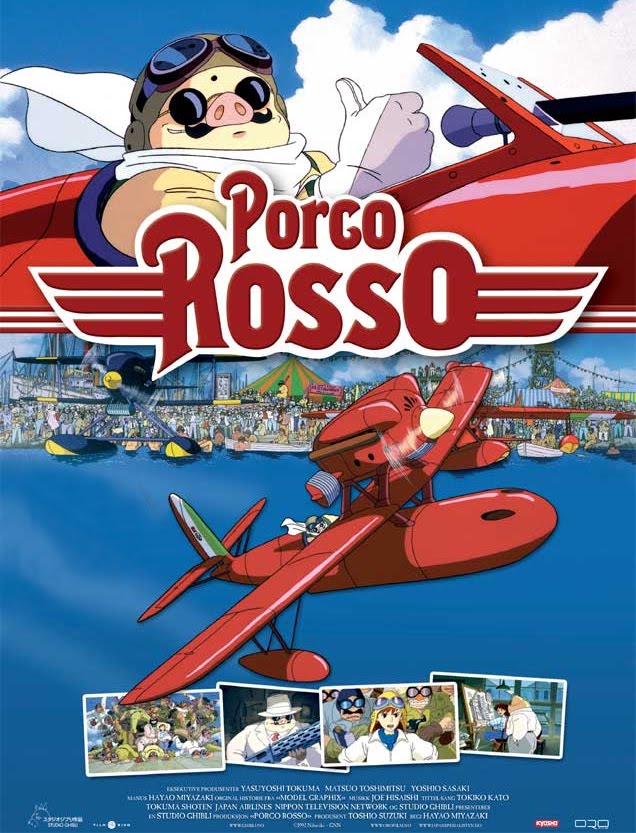
Besides telling tales of epic fantasy, Studio Ghibli can also be… a little silly and there’s no sillier movie of theirs then Porco Rosso. It’s the tale of a seaplane fighter pilot who quits the Italian army and becomes a bounty hunter after he mysteriously gets the head of a pig. Now living out his days in isolation, Porco Rosso is forced to get his plane repaired in Milan after getting shot down by American rival Curtis. There he meets Fio, a smart and talented engineer who teams up with him for his final battle with Curtis. Without going into detail you can tell that this is a rather silly movie, but its silliness isn’t what makes it great. Rather it’s the balance between silliness and seriousness that truly make it stand out.

Porco Rosso is a brilliantly funny movie, with witty dialogue and a complete exploitation of its very silly concept. Part of that is the Disney dub, which westernizes plenty of the jokes for the purpose of… well making them jokes. None of the changes betray the spirit and tone of the original and they’re welcome indeed. The cast does a great job, with Michael Keaton at the helm as Porco and a score of Disney stock actors to support him. The only really bad performance is Cary Elwes as the Texan Curtis, as his accent is absolutely awful. BUT I’m positive that this is played for laughs to make Curtis more of a caricature, because I’ve heard Cary Elwes do a half-bad American accent.

The characters aren’t as engaging and intriguing to me as the cast of Howl’s Moving Castle, but they are all surprisingly strong characters (at least on the protagonists side). Porco is one of those rare loveable assholes, who actually has an intriguing and complex background. Fio is just a great strong female character, but she isn’t afraid to show a little weakness and for me this sells her as a character. Gina, the hotel owner, is another great female character, as she strikes that balance between wanting a man without relying on men. On the flip-side, the antagonists are as one-dimensional as you can get, but it works because they’re played for laughs for most of the movie. I’d much rather watch well developed leads bouncing off of jokey villains then have the whole lot of them be half-developed. Thats not to say they’re cliche, as they still manage to be unique and engaging to watch.

Now for being as silly as it is, Porco Rosso isn’t afraid to get serious at times and it’s hard not to given it’s post-war setting. It’s the mark of a truly great kids film when the movie isn’t afraid to get serious, and Porco Rosso has that in spades. For example, we see plenty of people die (in the form of planes going down) and it’s clear that Miyazaki is putting a message of anti-fascism in the movie (not that there are many people who like fascism). Put somewhat simply, the dramatic serves as a good foil and break from the comedy and they feed off one other, creating a healthy symbiotic relationship. This is a pretty obvious statement that applies to most movies, but Porco Rosso pulls off that balance quite well.

I’m not sure why Porco Rosso isn’t more popular then it is, probably because it was in that dead zone of releases between Kiki’s Delivery Service and Princess Mononoke, but it really deserves more attention then it gets. It’s score is amazing (I paid attention this time), the animation is frigging gorgeous, especially for 1992, and its a brilliantly funny movie. On top of that, it’s a movie that can appeal to boys, girls, kids and adults. It’s a very very simple movie, and I didn’t take many notes while watching it, but it has everything that a great family movie, or any movie for that matter needs and I will be adding it to my collection as soon as possible.

Howl’s Moving Castle (2004) Review

acfc4-howl

Studio Ghibli is no doubt the “Feel good” studio. Almost all of their films are awe-inspiring fantasies or small stories that remind you of the good things in life and give a warm feeling inside. Now this is nothing new of me to say or for anyone to say for that matter, but it bears repeating because even with one of their most controversial works, Howl’s Moving Castle, I still get that Ghibli charm I just can’t get anywhere else.

Howl’s Moving Castle is the fantastical tale of hatter Sophie who after being saved by the mysterious wizard Howl gets cursed by his nemesis The Witch of the Wastes. The spell manifests itself by aging her tremendously and she decides to travel to Howl’s moving castle to see if she can get turned back. There she meets an annoying fire demon, a child apprentice and, of course, the mysterious and childish Howl. Sophie and Howl soon develop a romance, but their love seems in jeopardy as the country’s war escalates further and Howls involvement and demise seem inevitable.

Howl’s Moving Castle‘s quality is contested by fans because while it’s a good movie… it’s really not as good as other Ghibli works. At least thats my theory, and there’s evidence to back it up. Howl’s has strong characters, animation, and sound, far above most animated features, but it’s convoluted story weighs it down for people and prevents it from hitting that Ghibli standard.

I absolutely love the characters in Howl’s. It takes a while for you to get invested in them, but once they start acting as a family you can’t help but feel attached to them and really appreciate not only the individuals, but the cast as a whole. Even Billy Crystal’s Calcifer the fire demon, who’s pretty annoying for a good chunk of the movie has a hint of charm to him at the end of the movie. The aging dog that enters in the second half and the speechless scarecrow Turniphead both have a distinct personality despite a lack of lines and screen time. There’s just something about this ensemble and their chemistry that works for me and makes me want to see more.

The animation… do I even have to say it? It’s fucking gorgeous. It’s Ghibli and Miyazaki for christ’s sake. Everything from the character designs, backgrounds, and animation itself is high quality and meshes well. I really liked the design of the castle itself and it added a steampunk element that fit in this magic/science world. There are moments where you can tell that the animation jumps in quality so for an anime junkie who will notice that kind of thing it’s rather jarring, but for the average viewer it’s sure to not be a problem.

The soundtrack is standard Ghibli fare and rather unnoticeable which I guess means it did it’s job, but what I really want to talk about it the dub. I love the casting choices for the Disney dub and it’s probably one of the best out there. For the most part it’s unknown actors, but there a few celebrities in this cast. Christian Bale plays Howl and he does a fantastic job. I wasn’t sure he’d be able to pull of the more boyish aspects of the character, but he did and admirably at that. It’s a character archetype in Japan that has no real translation in the West and changes were made so if you’re a fierce loyalist to the original you may have problems with it. Billy Crystal, as I said before, plays Calcifer and does a fine job at that giving it that annoying touch without breaching into Jar-Jar territory. THE Lauren Bacall plays The Witch of the Wastes and she’s, of course, fantastic. She has this disney villainess quality about her, but it really works in this context. The rest of the cast is great too, but if I had any gripes it’s that the actress that plays the young Sophie has an accent that doesn’t match up with the speaking mannerisms of old Sophie and when they switch back and forth it’s quite distracting.

I suppose we should get to what doesn’t work… Howl’s Moving Castle is an extremely ambitious film in that it tries to juggle several different themes and plots. It unfortunately doesn’t succeed and the two aspects that end up suffering the most are the romance between Sophie and Howl and the war subplot. Now I understand the war subplots point of existing, that being to add a little tension and action to what would have been a rather quiet movie, but it could have been implemented better as it just pops in and out and there’s very little involvement or context with it. Sophie/Howl’s relationship gets pushed to the background while all this other stuff goes on and while you get a sense that their relationship is developing, there’s a lot of stuff I wish we could have seen to clarify it. One other fatal flaw of this film is that towards the end of the movie the plot just… goes all over the place. I’m not entirely sure how half of it worked or even what happened as the film tries to cram a lot into the last half hour and it doesn’t really take the time to explain properly. Everything’s jumbled and messy until the last two minutes where everything’s tied up in a neat bow, with too much convenience for my tastes.

I’ve said this about a lot of movies lately, but Howl’s Moving Castle is a ton of fun. It’s got a great mix between dark and light content as well as just enough maturity to keep an adult engaged while still keeping that childhood innocence for kids to enjoy. I thoroughly enjoy the characters and concept, and while I know there’s story flaws, who cares? If you know what you’re getting into and you let yourself get taken away by the characters, the weird pacing and underdeveloped story won’t matter to you (as much). A rottentomatoes rating or my recommendation really doesn’t do this movie justice as this is one film where I truly believe you must form your own opinion about so please check it out.

The Disappearance of Haruhi Suzumiya (2010) Review

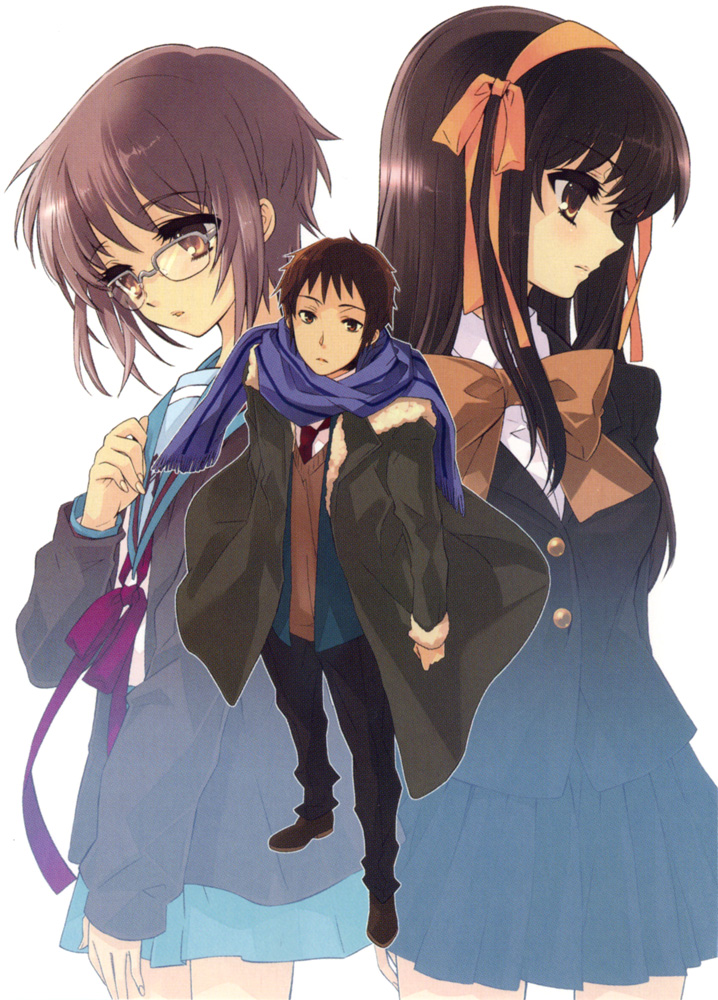
The Disappearance of Haruhi Suzumiya is the follow-up film to the beloved anime series of a similar title and in brief summary it’s fucking amazing. Taking the series as groundwork and using it to build a fantastic and heart-felt story, Disappearance manages to create a justified and satisfactory ending to the Haruhi story, even if you still want more at the end.

Disappearance picks up where the last episode (chronologically) ends and we are accompanied as always by the begrudging Kyon as he’s being dragged along for one of Haruhi’s schemes. The next day when he gets up and goes to school he finds that the world has changed and that no one knows who Haruhi is, or is there any evidence that she exists. With everything and everyone normal, Kyon struggles to find out what happened, what to do, and where in the world Haruhi is.

Lets get the technicals out of the way first. Practically everything about the original series is either maintained or improved on in Disappearance. The animation is even better then before, only showing weak spots on rare occasions. The music remains extremely well used, but this time there’s nary an annoying track to be found. The voice acting is astounding, with both Kyon (Crispin Freeman) and Nagato (Michelle Ruff) putting in memorable performances. The story is well paced and with little plot holes or objectionable content and the script is also good, with the same level of dialogue and wit being well balanced with more serious material. I really need to emphasize that the story is incredibly engaging and there are scenes that are so well done and impactful you may get goosebumps.

So yes. Go see it. Even if you haven’t seen the series give it a go. It’s themes are fascinating and it’s setting and story make it great for Christmas. What gets me most about this movie, and what really makes it a good film, is the characters. With a movie, you rarely have enough time to get particularly invested in the characters even if the story is more epic. With a TV show or anime you get invested, but the show rarely has a good finale to pay off your investment. However, with Disappearance, and with a lot of follow-up films to series (ie FMA, Firefly), you get an epic story that allows for all the proper payoffs with the characters you’d been hoping for. What Disappearance did for me was make me realize how much I was invested not just in Kyon, but in all of the characters. It had nods to subplots I had been curious about and it had callbacks to things that I had experienced with the characters (Endless Eight makes Nagato’s character parts all the more powerful). The SOS Brigade I realized meant the same to me as the Scoobies, Angel Investigations, the crew of Serenity, and the cast of Friends, Scrubs, HIMYM and Steins;Gate. They’re a group of people whose adventures I shared in a way, and who I got to see grow. There are so many poorly written movies and TV series these days that I’ll have to suffer through and hopefully along the way I’ll come across other characters to get invested in, but what Disappearance showed me by being a proper finale was that no matter what I can always come back to that club room and share in the adventures of Kyon, Koizami, Nagato, Ms. Asahina and the always happiness-spreading Haruhi Suzumiya. No I’m not some crazy fanboy of the series, as it’s in no way going to become an obsession of mine. It’s merely another moment of my life, but an enjoyable one. So don’t be a dummy and watch the show if only so that you too can take part in this excellent film. Unfortunately The Disappearance of Haruhi Suzumiya isn’t available for legal streaming anywhere, but you can pick up the DVD again from Bandai Entertainment (until they go out of business).

The Melancholy of Haruhi Suzumiya (2006/9) Review

The Melancholy of Haruhi Suzumiya is a 28 episode anime comedy series from Kyoto Animation. It’s fierce fanbase is one that will claim betrayal against anyone who hasn’t even watched it. While Melancholy may be a fun and certainly unique series, it definitely isn’t as worthy of such standing as shows like Madoka Magica or Cowboy Bebop. What Melancholy does offer is a light, fun show (for the most part) topped to the brim with energy and imagination.

Kyon is your extremely average high school guy, but what isn’t average is the extremely odd, but beautiful Haruhi Suzumiya who sits behind him in class. After an off-handed remark Kyon inspires Haruhi to start her own club and after recruiting him, the quiet sole member of the literary club Yuki Nagato, the so kawaii Mikuru Asahina and the mysterious transfer student Itsuki Koizumi the SOS Brigade is born. Their mission: to seek out strange phenomena and in particular find time travelers, aliens and espers. However, Haruhi isn’t an ordinary girl, as it’s revealed to Kyon by the alien Nagato, time traveling Mikuru, and the esper Koizami that Haruhi is actually the unknowing, but all-powerful god of the universe and it’s up to Kyon to prevent her from finding out and accidentally destroying it.

What makes Melancholy an interesting watch is two fold: The bat shit insanity of the situations Haruhi puts her friends in and those friends themselves. The characters are really what make this show, and despite having little drama between them they’re a fun bunch to get invested in. The narrator for the series, Kyon, provides a fun spin on things with his sarcasm and wit. It should be noted that in the english dub, which is what I watched, he’s played by the excellent Crispin Freeman and he does a bang-up job of it. While we’re on the subject the english dub for Melancholy is rather nice, with solid performances all around even if it doesn’t have the same energy that the japanese does. Anyhoo back to the characters. The three supporting characters all fit into their anime stereotypes, but by the end of the series you have a sense that they’re more then that and that kind of character growth justifies the cliches for me. Haruhi herself tends to be one note, but looking at the series as a whole you can see that she actually has a complicated psyche and is much more then just “weird.”

The stories of Melancholy are often times simplistic, but they get blown out of proportion by the stakes involved. Something as simple as making a movie all of a sudden becomes an exercise in tension with the fate of the world riding on it. The show doesn’t really have any filler episodes since the status quo doesn’t change once the world is set up and all of the arcs no matter how long or short aren’t particularly earth-shattering. In fact it seems to me looking back on the series that… nothing really happened. Yes there was stuff, but comparing it to how much they could have done and how high the stakes were they actually did shockingly little. To me at least. Thats not to say the stories of Melancholy are bad, most of them are filled with witty dialogue and fun character bits to stay entertaining and the show does manage to repackage many anime cliches with a hint of Haruhi magic to freshen them up again.

The animation, done by Kyoto is rather good, but rarely is anything astounding. All the characters look consistently good, but there are several points where the animation quality drops when they’re farther away or in motion. The style itself is nothing too special, but the designs given to concepts like The Closed Space are rather interesting. The openings and endings have a fun energetic style to them and fit the rather good music well. The endings also have the characters doing a choreographed dance, which became incredibly popular and has appeared in every Kyoto show since. The score of the series is okay, with a range of music from jazz to pop and for the most part it does it’s job, but there are a couple extremely annoying songs that distract from their scenes.

Now before I wrap up it’s important I address the story arc that has sparked lots of controversy all over the internet: “Endless Eight.” “Endless Eight” finds our characters stuck in a time loop, forever repeating the last two weeks of summer. The only way to get out is to figure out what Haruhi wants to do before summer ends. In the first episode we see the characters go about their summer activities and have a good time. In episode 2 the same activities occur, but this time it’s discovered that they’re stuck in a time loop and they don’t know what to do about it. In episode 3 the characters have forgotten the time loop since time has reset, and so they go about same activities until they discover the time loop, but still they can’t do anything about it. Episode 4 has the same activities and the characters discover the time loop, but can’t do anything about it. Episode 5-7 repeat this trend until in episode 8 Kyon finally figures out a solution and the loop is broken. Now it’s not like the episodes repeat themselves, they are all animated separately and little things in the dialogue and the character interactions do change. Despite these changes you are pretty much watching the same episode 6-8 times depending on how you weigh the differences in the first and last episode. This is obviously hard to get through, but like a few films I’ve mentioned (Redline, Gravity) it’s an experience. It achieves something greater then the sum of it’s parts by you watching it and you can only get that by watching the entire thing. “Endless Eight” puts you into the shoes of Nagato who remembers all 15, 532 repetitions since her “mind” transcends time/space. This loop is massively important to her character and with each episode you slowly get dragged down by the tedium of it and you get painfully sympathetic. So while “Endless Eight” is a hard arc to watch, it is important to … at least once. After an initial viewing you can pick and choose what episodes to watch and I would probably recommend parts 1, 6, 7, and 8.

What damaged The Melancholy of Haruhi Suzumiya most is that when it was aired, it wasn’t aired in the production release order, but rather in the chronological order of the events that occur. This completely screwed up the pacing of the series and while it did make some aspects of the story more obvious, they weren’t exactly unclear to begin with. So when watching Melancholy, make sure that the source you’re viewing it from starts with “Episode 00: Mikuru Asahina’s Adventure.” And with that said let me declare that The Melancholy of Haruhi Suzumiya is an extremely fun and entertaining show to watch, with lots of greats stories and characters that provide one of the most unique viewing experiences and one that could only be pulled off by anime. Melancholy is available from Crunchyroll and on DVD from Bandai Entertainment.

Redline (2011) Review

This review will be fairly short, because this movie is not something to be analysed, not to be pulled apart. I can’t explain to you why Redline is one of the greatest anime films of all time. There are certain movies that people call an experience and Redline fits that definition to a T. Redline is a movie I want to see in imax and in 3D and I rarely like both of those.
Redline is a racing movie, thats all you need to know, because the story is the last thing you should be caring about. It’s generic as shit and the characters are slightly more then cardboard cutouts, but you won’t care. You’ll be too busy looking at the amazing goddamn animation. The animation drawn by hand and over 7 fucking years. Do your eyes a favor and watch this movie because they will be orgasming.
Redline has its slow moments, but if you let yourself get a little invested in the characters and wait it out, you’ll be treated by a Gurren-Lagannesque finale of epic proportions. The race(s) in this movie are heart-pounding and tense as shit, with moments of awesome that make you want to jump out of your seat. All this excentuated by a fantastic soundtrack that will get your fist and blood pumping.
Do yourself a favor and watch this movie, get your bros together and WATCH THIS MOVIE. It’s an experience that will leave you stunned at the end and engrossed along the way. It’s hard for me to convey, but thats okay, because it’s incentive for you to watch it. Do it. Now.

Ghost Hunt (2006) Review

Amongst all the paranormal “reality” tv shows out these days, it’s refreshing to find a show honest about its fictionality. The anime Ghost Hunt certainly does cover a topic not often shown in anime, and the eastern perspective is rather refreshing for a paranormal aficionado such as myself. However, Ghost Hunt is little more then a mediocre anime, good for a casual watch, but forgettable at best.

Mai is a high school student (of course) who accidentally interferes in a paranormal investigation and the surprisingly young and narcissistic man in charge named Naru employs her as an assistant. From there they and a team of spiritualists help victims of haunting and possessions, growing closer together in the process. The show follows a case-by-case format, with cases taking between 1-5 episodes to solve. There’s no overarching plot, just small subplots carrying between the cases, and none of those are ever resolved (spoilers!). The cases themselves are predictable as hell and you’re often two steps ahead of the characters. On a few occasions there are twists and turns that are unexpected, but these aren’t nearly as plentiful as I would like. The show is generally engaging, but there are far too many times that I got easily distracted while they were just talking back and forth explaining everything.

Mai serves as our entry level character, allowing all the spiritualists to explain to her and the audience everything thats going on. Besides her ignorance, she also has an obnoxious can-do attitude that leads to her constantly complaining when things don’t go her way. Her high-school drama outlook constantly deflates any tension the episodes start to build and her crush on Naru was annoying to me, but I could see how it would be endearing to younger fans. The rest of the spiritualists are all fairly unique and engaging characters, and a few of them do develop by the end of the show. Naru is the quiet badass, who never does much except solve everything and explain it in a Holmesesque monologue. His backstory is very slowly revealed and most of it in the final episode, leaving you wanting more Naru and pissed that he could have been cool anytime before this. If you let yourself get invested in these characters, the show will pay off in a few touching moments.

The animation isn’t bad, but it certainly isn’t the show’s strong point. What does stand out about it is the way they chose to visualize the various spirits and demons. It was a treat to look at and made me appreciate the capabilities of an anime vs a live action show. The music is fine, it serves well to create the atmosphere, but there are far too few tracks and you end up hearing the same songs over and over. The intro is probably one of the worst I’ve ever seen. It’s nothing more then a mediocre song played over various “spooky” images. There’s nothing interesting there to see and it lasts for far too long.

Now as much as I’ve ragged on this show, there is a certain charm about it that I like. It’s something I haven’t really seen before. It’s a ghost hunting procedural show and surprisingly there aren’t really any shows like that, at least not ones as realistic as Ghost Hunt. Sure you have The real Ghostbusters and Supernatural or even Ghost Hunters, but none of those really show the more realistic type of spirits while investigating like a cop show. I also like how religion is portrayed in this show. Catholicism, Japanese occultism, Chinese practices, and science all work together to achieve various things and common goals. Every religion is on equal footing and that’s something I’ve always subscribed to, but never experienced in the christian heavy western world.

Ghost Hunt is an ok show, with some eye-rollingly stupid moments in it, but if you’re looking for something light to enjoy on and off as you wish, then maybe this is what you’re looking for. It’s very open, go read the manga ending will be infuriating to most, but with all the shitty endings American TV shows are getting these days you should be used to it by now. If you’re into the paranormal then you should definitely check this show out, and even if you just like watching SyFy shows, there will be something here for you to enjoy. You’re not going to want to go out and buy the blu-ray of this show, but some good times will be had. If you really like it, I recommend you check out the manga. It’s not necessarily better, but it does continue the story further and develop the characters a lot more. Ghost Hunt is available for streaming on Netflix, Funimation.com and Hulu.

Attack on Titan (2013) Review

Attack on Titan is the blockbuster summer anime of 2013. It’s the show everyone is talking about, and above all, raving about. In fact it almost seems like if you aren’t watching this show, you’re missing out on the coming of Christ. But is this show as amazing as everyone claims it to be? Welllllllll…

Attack on Titan drops us into a world where humanity is almost extinct and their natural predators are creatures called titans who are as tall as buildings and only exist to eat humans. Due to this danger, humanity has safely confined itself inside 3 incredibly huge walls, that is until an even larger titan shows up and smashes a hole in one of them. Here’s where we meet Erin Jaeger who barely escapes the destruction of his hometown with his two friends Armin and Mikasa. After witnessing his mother become titan lunch, Erin vows an oath to kill all the titans and thus he and his friends join the military. From there we encounter many an epic battle with the titans, but for the sake of spoilers I won’t go into details.

Attack on Titan utilizes a few incredibly long and extremely well paced story lines over the course of its 25 episodes. The almost nonstop action makes it extremely hard to not marathon this show. Well that and the infuriating cliffhangers that always manage to completely fuck over everything you thought you knew. It’s safe to assume that the strong pacing is thanks to Attack’s director Tetsuro Araki, whose other works include Death Note and High School of the Dead. If you’ve seen those shows, you’ll see his fingerprints all over this. Now that doesn’t mean that Attack is nonstop action. There are many points where the plot comes to a dead stop and we get some character interactions or back story, which actually service the show nicely.

Speaking of characters lets take a look at them shall we. Erin is the protagonist, yes, but it takes a really long time for him to develop beyond “Kill Titans!” and that journey is a rather inconsistent one at that. In order to progress his character we’re usually subjected to a confusing monologue about humanity or what-have you, but for the most part he just gets you pumped up with his screaming about willpower that makes you wonder if he’s going to put on a Green Lantern ring halfway through the battle. It’s not that he’s a bad character, just that he’s not as developed as some of the others tend to be, for example Armin. Armin is probably the most well rounded character in the show, starting out a Shinji-esque coward and growing into a loyal and brilliant tactical mind. Mikasa is portrayed as being flawless, and thus is the stone cold one of the crew as per anime clichés. Her lack of flaws is probably her greatest flaw, and although she had the opportunity to grow into a great character, the story unfortunately got in the way. The greatest and worst part of Attack is that any character can die, and thus talking about the supporting cast is almost impossible beyond generalizations. We meet a lot of people while the trio is in training and even more after they officially join, and it becomes hard to keep track of al of them. Unimportant characters become important, important ones fall to the wayside and amongst all the dying, it’s hard to keep track of who we’re supposed to care about. The rest of the people who exist in the world tend to only serve as an obstacle to our heroes, thanks to their stupidity, which comes off as just being human, so I can’t call it bad writing.

The animation is done by Studio Wit, a small offshoot of Production IG and for a fairly new studio, even with IG’s help, this animation is fucking gorgeous. The art style is rather unique, going for thick black outlines around all the characters to help distinguish them from each other and the background. The characters themselves have an inconsistency to their design, with varying degrees of how western they look. Some characters have more realistic faces, while others have the typical large anime eyes. This inconsistency is also reflected in the titan designs, as they vary from creepy joker to kawaii. If anything this is what will be off-putting to people watching the show. The art style of the characters complements the medieval setting and really makes it seem European or Germanic in its influence, particularly when the choirs boom in. One of the most unique concepts the show has is the 3D maneuver gear, which the soldiers use to get around and battle in. These enable them to fly through the air like Spider-man and whenever they use them in battle, the animation quality soars to an orgasmic degree as the camera zooms and rotates with them, all the while maintaining a fluidity and consistency that is truly movie quality. All these great shots come with a price though, as during the more quiet parts the animation becomes non-existent, with characters talking over pictures or just two pictures moving like a motion comic. And while this can be distracting, it is totally and utterly worth it.

The music is amazing with all the tracks able to emotionally manipulate you in just the right way. Even without the scenes to complement them, the songs are all high quality, with a spectrum ranging from rock and roll to orchestral choir being represented. The music may be a little distracting because of how powerful it tends to be, but fuck it who cares? The intros are both amazing, probably the best I’ve ever seen. The first intro is one most effective ever at being able to pump you up for the upcoming episode. It also, once again, features many Tetsuro trademarks, which is fine by me since he creates fantastic openings. The second intro is not as appropriate, but is more musically diverse and the accompanying animation makes it downright cinematic. The outros are less impressive, but they really don’t matter since you’ll be skipping to the next episode anyways.

What Attack on Titan does better then probably any anime I’ve seen to this point is creating a world for you to invest in and for it to construct and deconstruct at will. It’s a fairly basic military-fights-evil-plot at its core (i.e. Starship Troopers, FMA), but it also contains some of the most unique ideas I’ve encountered in a while. It’s got one of the best beginnings an anime has had, with a momentum that doesn’t stop until halfway through the show. Every world-shattering cliffhanger works because they’ve made the world seem comfortable despite the danger. It’s only until the second half where the momentum wears off that you can really see both the flaws and intricacies of not only the world, but the show itself. Attack on Titan is an action-filled blockbuster of anime, yes, but also has a strong story, beautiful animation, and decent characters to back it up. Is it perfect, by no means, but it’s one of the most enjoyable anime to watch and a thrill-ride that should not be missed. The ending is unfortunately non-existent, with the series before us feeling like a part 1 and 2 of a much greater story. Thanks to the popularity of this show, it’s hard to imagine it not getting a second series. A second series would hopefully alleviate many of the problems I have with the show, but we’ll have to see. If you don’t want to read the manga, I would recommend you hold off on watching Attack on Titan until closer to that imaginary second series’ air date, unless you want to join in with the legions of Otaku worshipping this show. Nonetheless, if you do choose to watch it now or whenever you’re reading this be prepared for a long marathon ahead of you, but please don’t let the hype raise your expectations too far. Attack on Titan is currently available from both Crunchyroll and Funimation.com as well as having been licensed by Funimation for an upcoming DVD/Blue-Ray release.

Madoka Magica (2011) Review

In the mass of Moe filled shows coming out these days, one would certainly not be surprised at the release of a cute magical girl show, and particularly from Studio Shaft who have done cutesy slice of life shows before. Indeed Shaft wanted us to think that Madoka Magica was nothing more then it appeared to be and it wasn’t until all the little Otaku sat down and saw the first few minutes that there was a sneaking suspicion that this show was not as it seems. Indeed Madoka Magica is not the happy-go-lucky anime its first couple episodes portray and is in fact a tragic deconstruction, and by doing so a subversion, of the magical girl genre.

For those who don’t know, the Magical Girl genre is one that consists of shows like Sailor Moon and Magical Girl Lyrical Nanoha. It for the most part consists of girls being approached by an unusual animal of some kind and being asked to become a magical girl in order to fight the forces of evil, leading to wacky adventures and super-powered transformation sequences that are used over and over. Madoka Magica follows much of the same story. A girl named Madoka is approached by the mysterious creature Kyubey who asks of her one wish, which will then be granted and she will become a magical girl. The only problem is that Madoka can’t come up with a good wish, and as she and her friend Sayaka discover more about the world of magical girls and the witches they fight, they become uncertain of whether or not they truly want to be magical girls. Unfortunately I can’t go much further then that, as I would rather not spoil this show more then I have to.

It’s the analysis of what really is at stake when these girls fight the reality warping witches and what the true motivation of Kyubey is that leads to this show having its… darker tone. This tone switch is sudden and it’s really when the deconstruction of the cute and innocent world that’s been created begins, as well as its ultimate subversion. Don’t be afraid if you don’t have much experience with Sailor Moon and its colleagues because the story of Madoka packs a punch either way. In the 12 episodes it has, it manages to create a whole world and set of characters that you get invested in and then somehow manages to wrap everything up at the end that it wanted to. For a story of this caliber, it’s very tight and I think the series being any longer would have been detrimental. As it is, Madoka Magica is an easy watch. Every episode is important and progresses the story, but if you don’t want to marathon it all at once there’s still enough recap to jog your memory.

Shaft has really put there all into this series, as it is fucking gorgeous. The labyrinths that the witches create are all composed of random imagery invoking many different visual styles and it’s some of the most unique art I’ve seen in a while. The animation outside of the battle scenes is nice, but not great. It’s a softer style that reinforces the Moe aspect of the show, but it works nice when contrasting it against the dark events to come. The character’s faces all have this odd sketchiness to them, that I actually like a lot, since it made them feel less like the products of K-ON! and more like actual characters.

The music is composed by Yuki Kajiura and its quality is easily on par with the rest of the show. Everything from the victory theme, tragedy themes, epic choruses, and ending song are all fantastic and fit the show to a tee. Fortunately, unlike other shows with her music, the songs don’t distract you from the story, merely adding to it and this is due to (again) how engrossing the story is. The acting in the Japanese track is phenomenal, as far as I can tell, and far surpasses the english dub. It’s not that the dub is particularly bad, it’s just that the characters are defined by a lot of Japanese conventions that are hard to convey in English. I have to recommend subs on this one.

Madoka Magica is a show that’s hard to explain why it’s good without ruining what makes it good. Its play on expectations is exactly what makes its more dramatic moments work. At the end of the series you’ll find yourself attached to the characters, invested in the story and familiar with the world. Above all though, you’ll be satisfied. For only 12 episodes Madoka Magica is a marvel amongst modern anime. There’s really no excuse not to watch it. If the premise isn’t interesting to you, then don’t worry it’s not supposed to be and if you’re worried about time and availability it’s on Crunchyroll for streaming at the time of this review. If you’re tired of mediocrity or you recently got into anime then by all means watch Madoka Magica, you won’t regret it.